
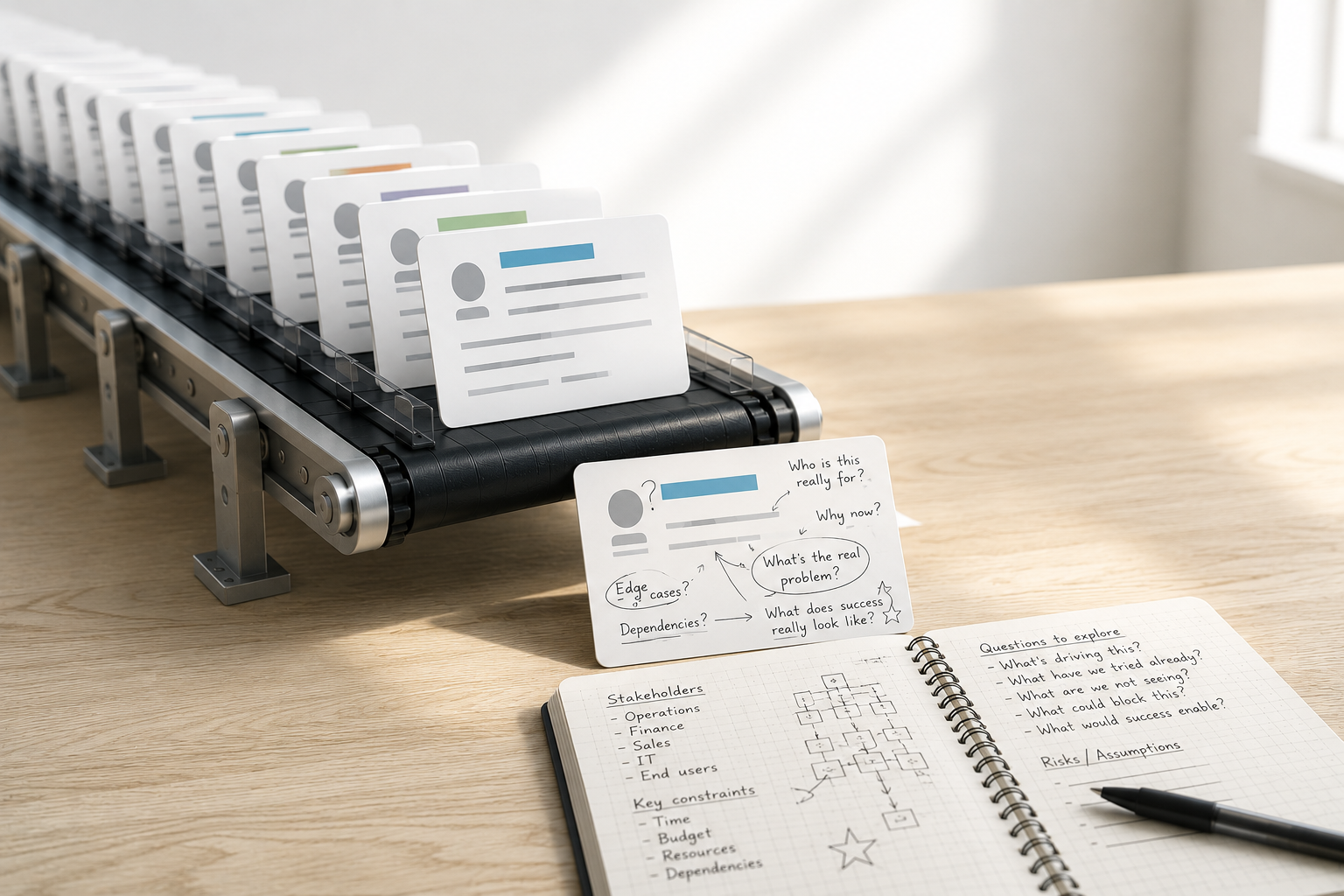
One of the most common things BAs describe when they start using AI tools is how much faster they can write user stories. What used to take an afternoon, or weeks, now takes an hour. A backlog that would have required a week of writing can be drafted in a day. The output is clean, structured, and follows the right format.
It is easy to look at this and feel like a win. For many teams, it genuinely is a productivity gain.
But there is a different question worth asking: are you actually doing better requirements work, or are you just producing more requirements artifacts faster?
Those are not the same thing. And the difference matters more than most teams realize.
What User Stories Are Actually For
User stories were never meant to be documentation artifacts. The original intent, from the people who coined the format, was that a user story is a placeholder for a conversation. The value is not in the card. It is in the discussion the card prompts.
A well-written user story gets a developer, a BA, and a product owner in the same room talking about what a user actually needs, why they need it, and what done looks like. The story is a starting point, not a specification.
When AI writes your user stories, you get the artifact without the conversation. You get a well-formatted placeholder for a discussion that may or may not actually happen. If the conversation happens anyway, the AI-generated story is a useful starting point. If the conversation is skipped because the story looks complete, you have produced documentation while avoiding the work that actually mattered.
The Gap AI Cannot See
The most important context in any requirements conversation is the context that is not written down anywhere: who the stakeholders are, what the organizational dynamics are, what the history of this problem is, what the real constraint is versus the stated one.
AI does not have that context. It can generate a user story that follows the correct format and sounds plausible based on the information you provided. It cannot know that the user group you are building for has been asking for this feature for three years and has very specific opinions about how it should work. It cannot know that the metric you are being asked to improve is a proxy for a different problem that the team has been reluctant to name directly. It cannot know that one of your key stakeholders will reject anything that requires a process change on their team.
The requirements work that surfaces that context is not faster because you have a better writing tool. It is the conversations, observations, and analytical thinking that no AI can do for you.
The Difference Between Output and Thinking
This is the distinction that matters most: AI can help you produce requirements outputs. It cannot do your requirements thinking.
Requirements thinking is the work of understanding a problem deeply enough to know what needs to be built. It involves asking the right questions, listening for what is not being said, synthesizing input from multiple stakeholders who have conflicting perspectives, and making analytical judgments about what matters and what does not.
AI can take the output of that thinking and format it quickly, draft it for review, and identify gaps in what you have written. These are genuine contributions. They let you spend more of your time on the thinking and less on the formatting.
The risk is when the formatting happens without the thinking. When a BA uses AI to write user stories based on a brief conversation without doing the deeper elicitation work. When the backlog looks full and well-formatted but the team has not actually developed shared understanding of the problem. When speed of output is mistaken for quality of analysis.
The Quality Signal
Good requirements work has always been measured by the quality of shared understanding it creates, not the quality of the documentation it produces. AI tools change the documentation piece significantly. They do not change what good requirements work actually achieves.
What This Means for BA Development
For BAs who are developing their skills in an AI environment, the implication is clear: invest in the capabilities that AI cannot replicate.
Get better at elicitation: the facilitation skills, the listening skills, the ability to ask questions that surface the real need behind the stated request. Get better at synthesis: taking diverse and sometimes conflicting input and finding the pattern that clarifies the problem. Get better at stakeholder navigation: understanding the organizational context well enough to know whose perspective matters most and how to get alignment across competing interests.
These are the capabilities that make a BA irreplaceable in an AI-assisted environment. They are also, not coincidentally, the capabilities that are hardest to develop and most worth investing in.
My five new AI/BA courses (live, online, interactive, instructor lead) are designed around exactly this: helping BAs develop the analytical and facilitation capabilities that matter most in an AI-accelerated environment, not just the tools to produce faster output. Come work on the skills that will keep you ahead. Find me at maven.com/angela-wick.