
It is 2 a.m. An AI agent reviews a customer’s refund request, checks it against policy, and denies it. The customer escalates on social media by morning. Leadership asks a simple question: whose decision was that?
The room goes quiet. The developer built what was specified. The product owner approved the feature. The policy team wrote the refund rules years ago for human agents. The vendor says the model behaved as designed. Everyone touched it. Nobody owns it.
This scenario is playing out in organizations right now. And it points to some of the most important business analysis work of this decade.
Why Accountability Gets Lost
With traditional software, accountability was fairly clear. Systems executed rules that people defined. When something went wrong, you traced it back to a rule and the person who owned it.
Agents work differently. They interpret, reason, and act. Their behavior is probabilistic, so the same situation can produce different outcomes. They act at a speed and volume that outruns human review. And they often sit across processes that several teams own pieces of.
That combination creates gaps. Decisions get made that nobody explicitly authorized. And accountability, if it is assigned at all, gets assigned after something goes wrong.
Accountability Is a Design Decision
Here is the shift for BAs: treat accountability as something you design before an agent goes live, alongside its scope, tools, and success metrics.
Nobody else on a typical team is positioned to do this. Engineers focus on how and whether the agent and models work. Risk and compliance focus on whether it breaks rules. The BA can see across all of those and ask the question that ties them together: for every decision this agent makes, who answers for it?
Tip 1: Map Every Decision the Agent Makes
Start by listing the decisions, separate from the tasks. An agent that “handles refunds” might make five distinct decisions: is the request complete, is it eligible, what amount applies, should it be escalated, and how should the customer be told.
For each one, classify it:
- Agent decides: low risk, reversible, well-defined rules.
- Agent recommends, human decides: higher stakes or judgment-heavy.
- Human only: legal, ethical, or reputational exposure too high for automation.
This simple map often reveals that the agent was quietly making decisions nobody intended to delegate.
Tip 2: Name an Accountable Owner for Each Decision
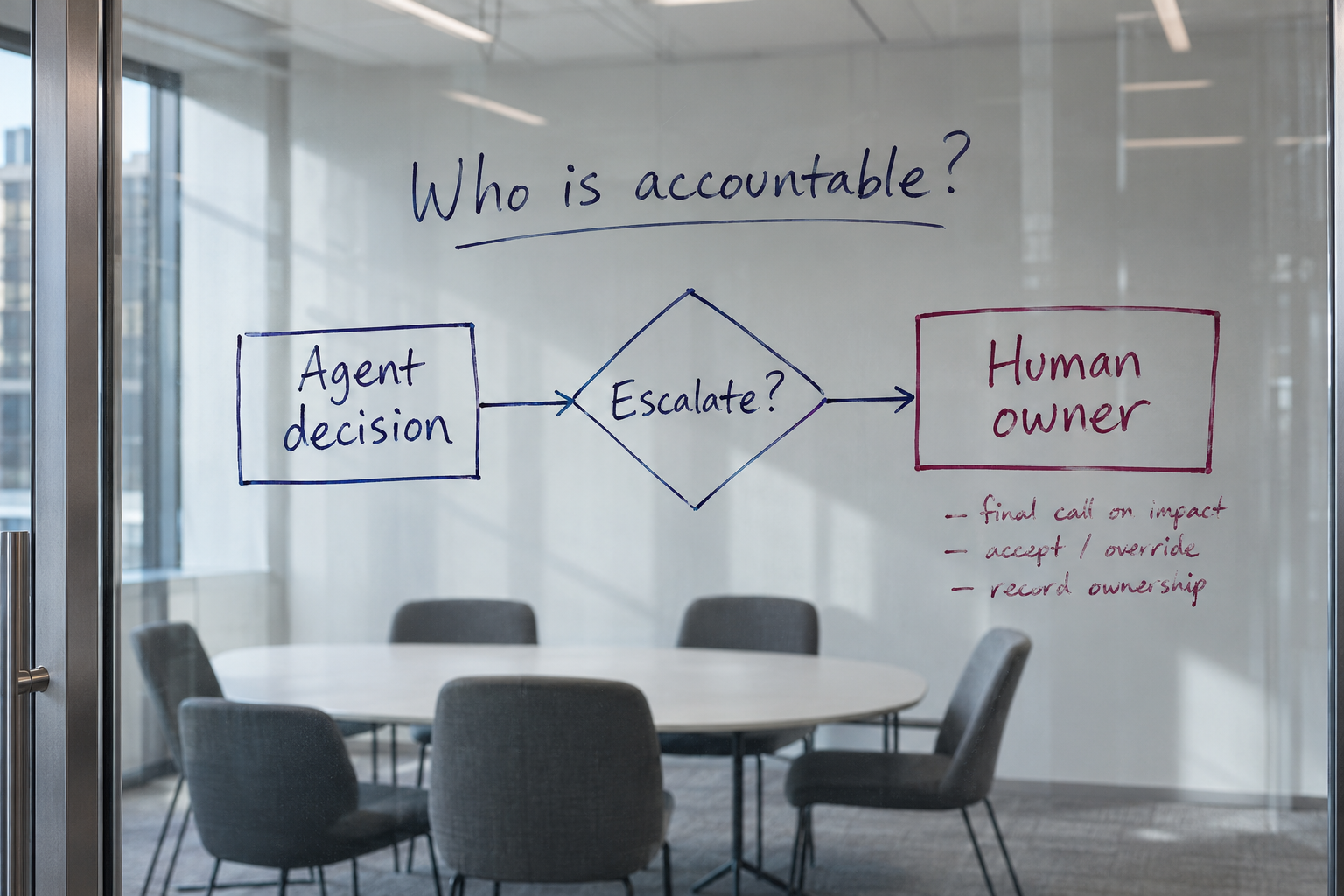
Every decision on your map needs a named HUMAN owner, even the ones the agent makes on its own. That owner sets the rules, reviews performance, approves changes, and answers when something goes wrong.
The owner is usually a business role. The refund eligibility decision belongs to whoever owns refund policy, regardless of who built the agent. Making that explicit changes how seriously the business engages with the design.
Tip 3: Design the Escalation and the Evidence Trail
Accountability needs two things to work in practice.
First, clear escalation paths. When should the agent stop and hand off? What information does the human receive? How quickly must they respond?
Second, an evidence trail. For any decision, can someone reconstruct what the agent saw, which rules it applied, and why it acted? Without that, accountability is just a name on a chart.
The BA as Accountability Architect
As agents take on more of the work, organizations will need people who can define who decides what, design the handoffs, and make the whole system answerable. That is business analysis at its most strategic.
When the next leader asks “whose decision was that?” the answer should already be written down. Help your organization get there first.
Learn to Design Accountable Agents
My Maven course series covers decision rights, escalation design, and accountability for agentic AI, including hands-on practice with real agent scenarios.
Visit www.maven.com/angela-wick to explore current courses and upcoming cohorts.
Agents can act. People must answer. BAs can design the connection.