
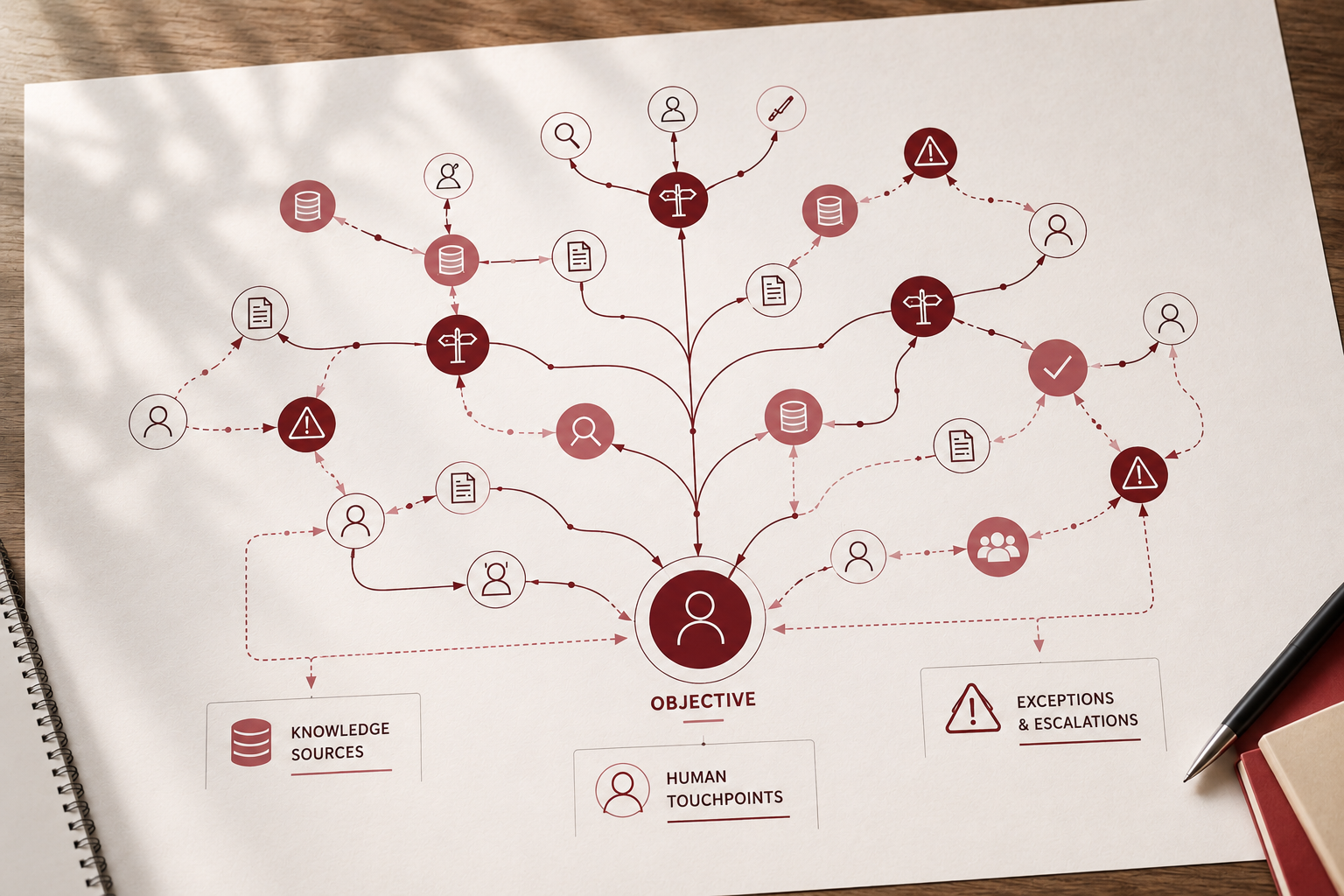
An agentic AI project is a different category of work from a traditional software implementation. The technology is different, the risk profile is different, and the requirements work is different in ways that catch many teams off guard when they encounter it for the first time.
The analysis is massive, the facilitation of decisions from business teams is huge, and the change management of how agentic AI changes people and processes are larger than most teams and orgs understand.
This is a practical guide to what that requirements work actually involves.
Start with the Measurements of Success
Every agentic AI system exists to accomplish something. Before any other work happens, that objective needs to be stated with precision.
This sounds obvious, and it is harder than it sounds. Objectives for agentic systems are often stated in ways that are too vague to be useful: build an agent for x, automate the review process, improve response times, reduce manual work. A well-stated objective for an agentic system describes what the system needs to achieve, under what conditions, and with what constraints.
The requirement might be: the system should review all incoming vendor contracts and flag any that contain non-standard payment terms, missing indemnification clauses, or liability caps below our threshold, routing flagged contracts to the appropriate legal reviewer with a summary of the issues identified. That is specific enough to design against, nor measure and monitor the success.
Getting from a vague goal to a precise objective requires conversations with the people who will use the system, own the process, the people who currently do the work it will automate, and the people who will be accountable for the system’s decisions. It requires pushing past the first answer to understand the real intent and the real constraints.
Map Every Step and Decision the Agentic System Will Make
Once the objective and success measures are clear, the next step is decision mapping. An agentic system is fundamentally a decision-making system. It perceives information, evaluates options, and takes action. Every significant action is downstream of a decision.
Decision mapping for an agentic system asks: what decisions will this system make, in what sequence, based on what information, and with what authority? Which of those decisions are consequential enough that a human should be in the loop? Which can the system make autonomously?
This mapping work often reveals that the number of decisions the system will make is much larger than the initial project framing suggested. A workflow that looks simple at the process level may involve dozens of analytical judgments when you look at it at the decision level.
It also reveals the risk landscape. The decisions with the highest consequence, the highest uncertainty, or the most dependence on organizational context; it takes careful design.
Define What Good Output Looks Like
One of the most important and most often skipped steps in defining an agentic AI project is a clear definition of what good output looks like for each task the agentic system performs.
AI systems, including large language models, do not have an inherent sense of quality, and they are probabilistic. They optimize for what they were trained to optimize for, based on the data and instructions they are given. They produce output that is plausible given their inputs. Whether that output is correct, appropriate, complete, and aligned with business intent is a judgment that requires human definition.
For each key output the system produces, we should specify: what does an acceptable output look like, what does an unacceptable output look like, what are the most common failure modes to test for, and how will quality be assessed at scale?
Getting agreement and alignment on this requires subject matter expertise and analytical rigor. You are effectively codifying the judgment that experienced humans apply when they review this kind of output. That judgment is often implicit and it takes skilled elicitation to make it explicit enough to be useful as a specification for an agentic system.
Specify the Knowledge the System Needs
Agentic systems make decisions based on what they know. The knowledge they have access to determines the quality of those decisions. Too much knowledge and things get fuzzy, too little and they do not have enough context. Planning and requirements for an agentic system need to address what knowledge the system needs, where that knowledge will come from, how it will be maintained, and what happens when it is incomplete or outdated.
This is a category of requirements that traditional methods do not address well. Most requirements frameworks assume that the system will be given data and will process it according to rules. Agentic AI systems do not just process data to rules. They reason over knowledge and make inferences that depend on the quality and completeness of that knowledge.
A BA working on an agentic AI project needs to treat knowledge requirements as a first-class concern: what does the system need to know to do its job, is that knowledge available and reliable, and what are the gaps that need to be filled before the system can operate safely?
Design the Human Interaction Points
An agentic system does not operate in isolation from humans. There are points in most agentic workflows where human input is required, human review adds value, or human override is necessary.
These interaction points need to be designed deliberately, not left to emerge as the system is built. The requirements should specify: where will humans interact with the system, what information will they see, what actions will they be able to take, and how will their input feed back into the system’s behavior?
Good design of human interaction points makes the difference between a system that empowers the humans working with it and a system that creates confusion, friction, and workarounds. BAs who have experience designing user-facing requirements have skills that transfer directly here.
Anticipate the Edge Cases
Agentic systems will encounter situations they were not designed for. Requirements work for an agentic project should explicitly include edge case analysis: what situations might the system encounter that fall outside its intended scope, what should the system do when it encounters them, and how does it signal to a human that it needs help?
This is harder to do well for agentic systems than for traditional ones because the operating space is larger and less predictable. An agentic system that can take actions in an open-ended environment will encounter more edge cases, more quickly, than a rule-based system operating on structured data.
The goal is not to anticipate every edge case, which is impossible, but to design a system that handles the unexpected gracefully: stopping, escalating, and preserving state in a way that allows a human to intervene without losing the context of what the system was doing.
If you want a structured approach to requirements work in agentic AI projects, my Maven course Analysis for Agentic AI walks through the specific methods and frameworks and a playbook that work in this environment. We cover agent and multi-agent definition, instructions, decision mapping, knowledge requirements, oversight design, and the edge case analysis that makes agentic systems trustworthy. Find me at maven.com/angela-wick.
Putting It Together
Requirements work for an agentic AI project is requirements work. The core skills are the same: elicitation, analysis, documentation, validation. What changes is the timing, approach, subject matter, the categories of requirements that need to be addressed, and the level of rigor required for the decisions that carry the most risk.
BAs who approach agentic AI projects with the same analytical discipline they bring to any complex requirements challenge will find that their skills are more relevant, not less; and yet need a new lens and playbook to execute those skills with. The work is challenging and the learning curve is real, but the underlying competency is one that experienced BAs already have.